

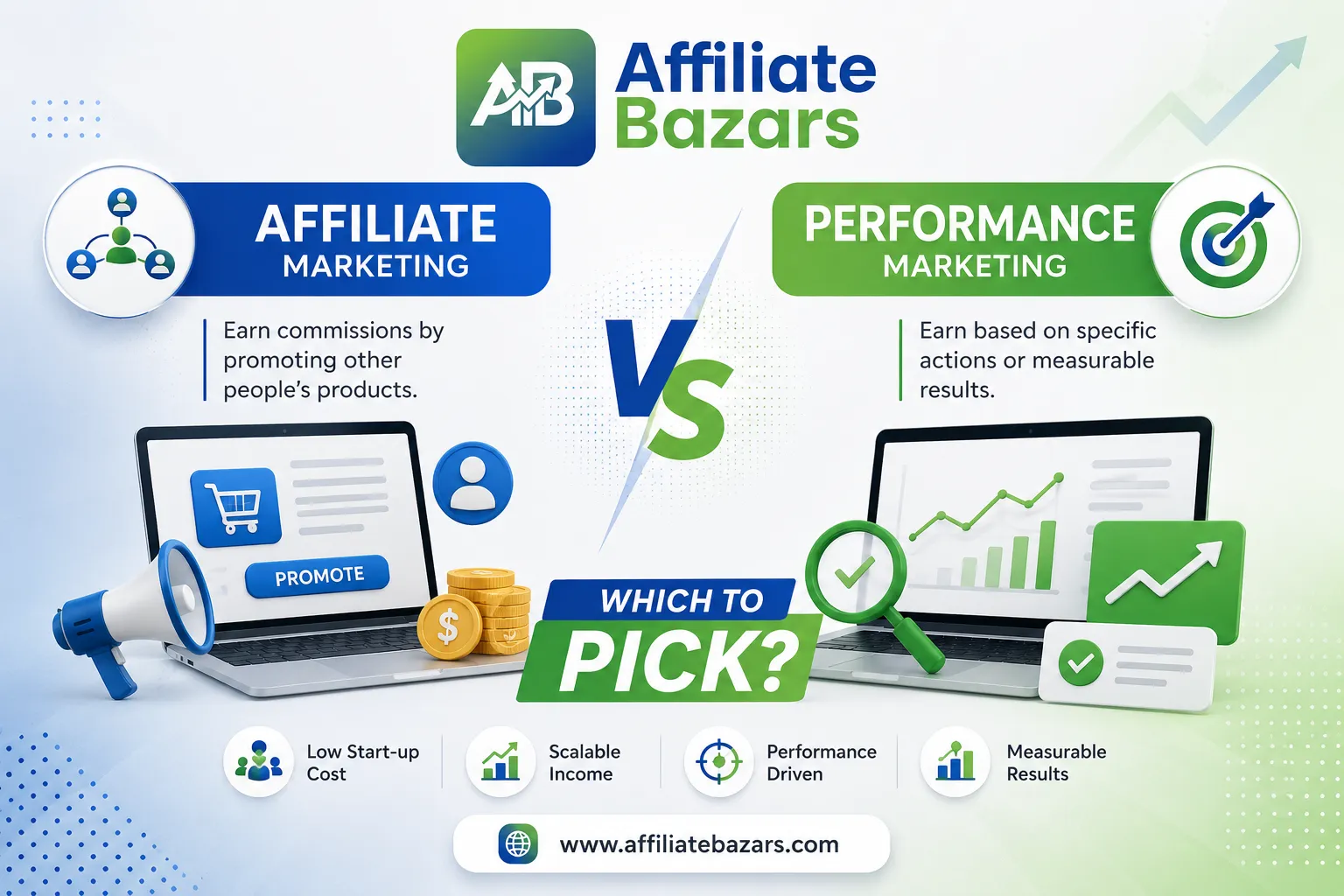
Marketers often look at Affiliate Marketing vs Performance Marketing to choose the right method for high ROI-based campaigns. Affiliate Marketing is the type of performance marketing that pays third-party partners ( affiliates) to drive actions or sales, and performance marketing covers a wide range of channels like influencer marketing, paid ads, and affiliate programs, where the brands only pay when measurable results occur.
Let us read this blog and know the difference between Affiliate Marketing vs Performance Marketing, and choose the right option for maximum impact.
Affiliate Marketing: The Power of Partnerships
Affiliate marketing is the type of performance marketing where the business partners with publishers or affiliates who promote products or services in exchange for commission.
In this, the Affiliates can promote products or services through various channels, including their website, blog, social media, or email list. When a customer clicks on an affiliate link and makes a purchase through it, the affiliate earns a commission.
The commission structure varies based on the agreement between the affiliate and advertiser. Its aim is to broaden the reach of the advertiser’s products or services and boost sales through a network of trusted affiliates.
Key Features
- Commission-Based: Affiliates earn a commission on every sale or lead they generate.
- Third-Party Involvement: It includes working with bloggers, influencers, and other online entities.
- Tracking Systems: Unique tracking links are used to monitor affiliate performance.
Benefits
- Cost-Effective: You pay only for results, like leads or sales.
- Extended Reach: You can access the affiliate’s audience base.
- Scalability: It’s easy to add more affiliates to increase your reach.
Performance Marketing: Results-Driven Approach
Performance marketing is a marketing method where advertisers pay for specific actions, like leads, clicks, conversions, rather than paying for impressions or ad placements. It means advertisers only pay when the desired action occurs.
It includes tactics like pay-per-click advertising, email marketing, and search engine optimization. The goal of performance marketing is to maximize the return on investment by focusing on measurable outcomes.
Key Features
- Diverse Channels: It includes PPC (Pay-per-click), SEO (Search Engine Optimization), content marketing, and more.
- Real-Time Analytics: You can get instant feedback on campaign performance.
- ROI-Focused: It focuses on measurable results and ROI.
Benefits
- Flexibility: You can choose from various channels on the basis of your target audience.
- Transparency: Real-time data allows for fast adjustments.
- Optimized Spending: Your budget is directed toward strategies that give you results.
Affiliate Marketing vs Performance Marketing: Comparison Table
Here is the comparison analysis of affiliate marketing vs performance marketing
| Factor | Affiliate Marketing | Performance Marketing |
| Definition | It is a partner-based strategy where affiliates promote products and earn a commission on each sale or action. | A wide, results-driven approach where brands pay for specific actions like leads, clicks, and sales across various channels. |
| Who Drives It | External partners (affiliates) like influencers, bloggers, and media sites. | Managed in-house or by agencies by using paid ad platforms and tools. |
| Control | Less control. You rely on the affiliate’s content, tone, and timing. | Higher. You control targeting, creative, spend, and optimization. |
| Channels Used | Social media posts, newsletters, Blogs, YouTube, deal/coupon sites. | Google Ads, TikTok Ads, Facebook/Instagram Ads, affiliates, influencer partnerships, native ads. |
| Cost Model | CPA (Cost Per Action), pay-per-sale, or lead. | CPA, CPL (Cost Per Lead), CPC (Cost Per Click), CPM (Cost Per 1,000 impressions), sometimes Rev Share. |
| Payment Timing | After the result is delivered | Vary payment timings, some models charge upfront (CPM/CPC), others after results delivered (CPA/CPL). |
| Tracking & Attribution | Relies on affiliate networks or software to track clicks and conversions via unique links or promo codes. | Uses analytics platforms (e.g., Google Analytics, ad dashboards) for granular tracking at multiple touchpoints. |
| Best For | Brands that want to grow through third-party advocates with minimal upfront spend can choose affiliate marketing. | Brands that focused on scaling campaigns fast and real-time optimization across multiple channels. |
| Scalability | Based on how many quality affiliates you can recruit and retain. | Highly scalable, especially with the right creatives, budget, and automation. |
| Examples | Amazon Associates, ShareASale affiliates, and blog reviews with affiliate links. | Google PPC campaigns, influencer campaigns, and Meta lead gen ads, with tracked ROI. |
Which One Should You Choose?
No single marketing method is best. It depends on your goals, budget, and desired level of control.
Choose Affiliate Marketing if
- If you want to engage with an audience of bloggers, YouTubers, or influencers without paying upfront
- You want to tap into the audience of bloggers, YouTubers, or influencers without paying upfront.
- You don’t have an in-house ads team or media buying skills.
- You’re launching a new product and want organic-style promotion.
Choose Performance Marketing if
- You want to run highly targeted campaigns on platforms like Meta, TikTok, and Google.
- If you want quicker feedback and optimization control.
- You have a marketing team to manage ads.
- You’re scaling and want to control the story, creative, and budget.
Many brands use both methods, and they complement each other well. Affiliates can bring long-term sales, while performance ads provide real-time reach and control.
Conclusion
Both Performance marketing and affiliate marketing are effective strategies to promote your business products or services. Its differences lie in payment structures, relationships between advertisers and affiliates, control over promotions, and target audiences.