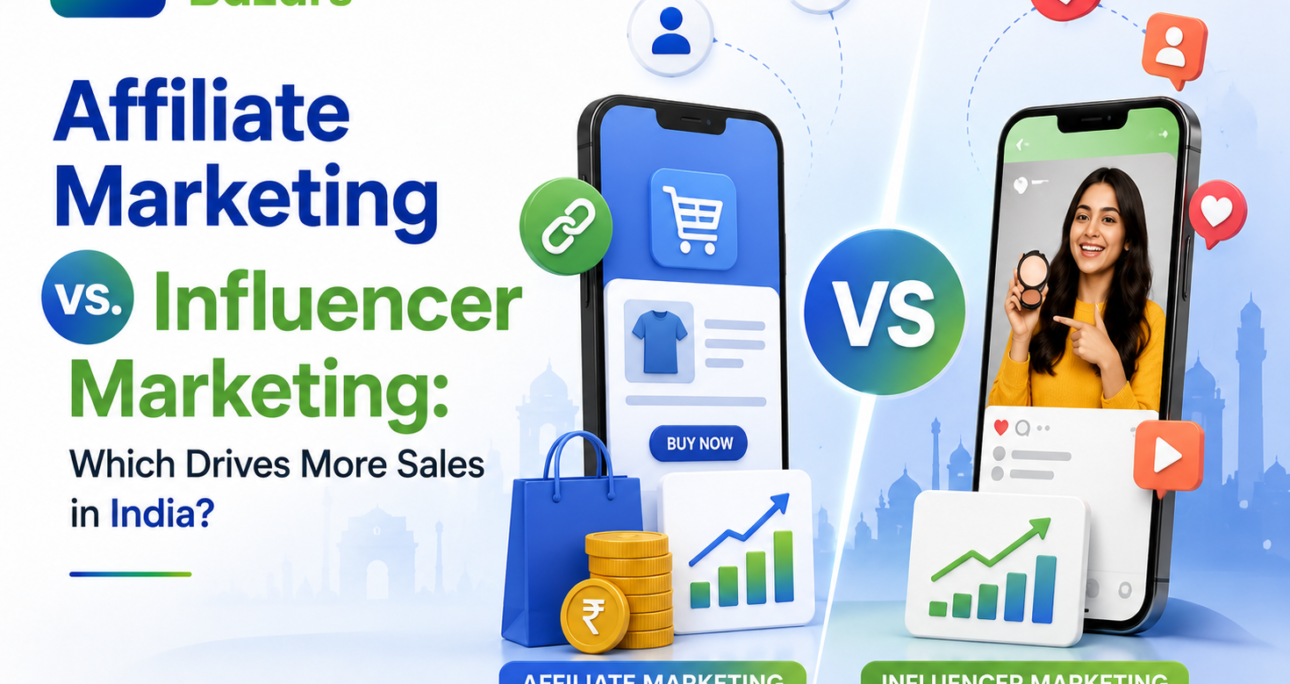
Choosing the right marketing strategy, especially between the affiliate marketing strategies and Influencer Marketing, is difficult. It is because both promote products, and both rely on partnerships. But it generates the results in different ways. So picking the wrong marketing strategy may waste your budget.
It is important to choose the right marketing strategy to unlock the growth of your business. In this blog, we tell you the difference between affiliate marketing vs influencer marketing and help you to decide the best strategy for your business.
Understand affiliate marketing
The affiliate marketing strategy is a process referred to as promoting products/services through tracked links and earning a commission on sales. It is beneficial for the niche sites and content owners, and helps them to generate revenues with traffic & conversion optimization.
Pros and Cons of Affiliate Marketing
| Pros | Cons |
| Easy to start with minimal investment by joining affiliate programs | Popular niches like tech, fashion, and beauty are already saturated with affiliates. |
| After setting up the affiliate account, you can earn money 24/7 with minimal effort. | Take time to build traffic and trust before witnessing consistent sales. |
| Various monetization options like physical goods, digital courses, and software | Commission rate or sudden policy changes on affiliate platforms can affect earnings. |
| High traffic and better content result in exponential growth in earnings | Conversions may not get accurately credited always |
| Affiliates can collaborate with the affiliate’s brands for growth and credibility. | Affiliates need to follow strict disclosure and privacy guidelines. |
What is Influencer Marketing?
Influencer marketing is the marketing in which brands pay creators to promote products on social media platforms. The marketing is performed through a pay-per-sale model with commerce links. The influencer market of India is large and fast-growing, with a value in the multi-hundred-crore INR range and millions of creators. However, income distribution is uneven, with only a small percentage of influencers earning the majority of the revenue.
Pros and Cons of Influencer Marketing
| Pros | Cons |
| Brand visibility and High engagement | High cost |
| Audiences trust influencers more than direct brand ads | Not every campaign guarantees measurable conversions and revenues. |
| Influencers personalize brand messaging via creative content formats. | Some influencers may have fake followers, which affects your ad campaign’s authenticity. |
| Brands can target specific demographics effectively. | Brands have less say over tone and content after handover to an influencer. |
| Influencer promotions can result in more organic mentions and shares. | Influencer-driven visibility peaks quickly unless part of a long-term partnership. |
Affiliate Marketing vs Influencer Marketing
Let us compare the different aspects of affiliate marketing and influencer marketing to understand which is the best option for higher sales.
| Factor | Affiliate Marketing | Influencer Marketing |
| Payment Structure | Pay per action ( lead, sales, etc.) | Fixed fee or per post |
| Relationship | Performance-based | Relationship-based |
| Scalability | More scalable | Less scalable |
| Focus | Grow sales | Building trust and rapport |
| Audience | Reach a broader audience | Reach a specific audience only |
| Challenges | Tough to find high-quality affiliates | Tough to identify the right influencer |
| Benefits | Cost-effective, measurable, and trackable | Reaches a large audience, builds trust |
The decision between affiliate marketing services in Noida and influencer marketing is based on your specific goals and budget. If you want an affordable method to drive sales, then affiliate marketing is the best choice. If you want to build trust with an audience, then you can choose influencer marketing.
The ROI Comparison: Influencer Marketing vs. Affiliate Marketing
When it comes to ROI, the differences are clear. Here are some key factors brands should consider while choosing between affiliate or influencer marketing
- Influencer marketing ROI is usually qualitative
Success is measured by reach, awareness, sentiment, and cultural relevance. A single post from an influencer can create strong buzz online and drive sales, but those profits do not last long. It gives you unstable ROI and is often based only on viral moments or the appeal of a single creator.
- Affiliate marketing ROI is very quantitative
As per the industry benchmarks, affiliate programs can yield about $12 in revenue for every $1 spent. It focused on the conversions. It gives you trackable and scalable ROI. As you recruit more quality affiliates, you get growing results with time.
Note that if a brand relies too much on influencer marketing, costs might exceed returns. Conversely, if it focuses only on affiliate marketing, it could miss out on the cultural relevance that boosts awareness and loyalty. So, a combination of both marketing strategies is recommended to stay within your budget and enjoy long-term ROI.
Conclusion
Choosing between affiliate marketing strategies and influencer marketing depends on your business goals. If you are seeking performance-driven growth, then get affiliate marketing services in Noida. In this, you only pay commissions when sales occur. It is a scalable and low-risk marketing strategy. These options are suitable for the ecommerce stores, SaaS businesses, and digital companies.
If you want to boost brand awareness and build audience trust, then choose Influencer marketing. In this, creators can show case your products to broad communities and build social proof. The best brands don’t only choose one strategy; they use both. Influencers generate visibility and excitement while affiliate programs convert that attention into measurable sales and ongoing revenue. For sustainable growth, the real opportunity lies in combining both strategies